- Jun 26, 2025
When to Use Flash in Photography
- Dejan
- Light & Lighting
Published in the Free Content
If the light conditions are good when you're photographing, there's no need to use a flash. A flash unit is simply an additional light source and becomes unnecessary when the existing light is already satisfactory. However, if the light on your subject is inadequate, effectively using a flash may be the only way to capture the desired photograph.
THE LOGIC BEHIND THE CHOICES
When should you use a flash in photography?
The determining factor is the quality of light in the location where you take your photographs. If the light quality is adequate, using a flash is redundant. On the other hand, if the light quality is poor and the image you envision cannot be achieved, using a flash becomes essential. Poor light quality can stem from several factors, including intensity, direction, and color.
[This raises a very important question: Do you understand what the quality of light is? If not, you are missing an essential piece of photographic knowledge. I suggest you stop all other photo projects and first ensure you understand the quality of light. I can assure you that without this knowledge, you will not make significant advancements in photography.]
This is what makes a flash unit exceptionally valuable for photographers. When faced with unfavorable light conditions, instead of ending your session, you can use your flash to improve the lighting and continue photographing.
In the example shown in Figure 1, you can observe the power of using flash in photography. On the left side, you see the subject captured in available light of very poor quality, which results in a lackluster image with minimal interest - just a simple snapshot. On the right side, the same scene is photographed using a single flash unit. The flash effectively overrides the existing lighting conditions, creating a much more compelling photograph.
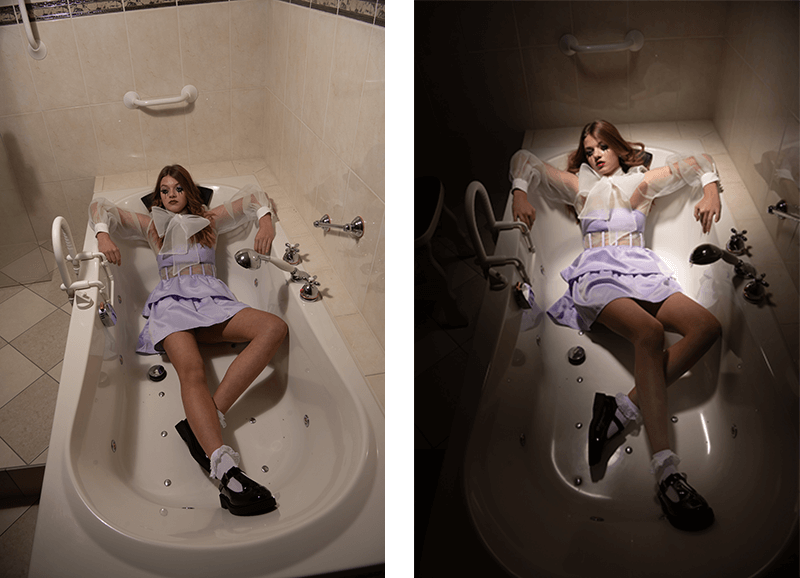
Figure 1
External flash
When I refer to using a flash, I always mean an external flash. Built-in flashes have significant limitations and are therefore not considered in this discussion. While a built-in flash may enhance your photo in an emergency, it often fails to achieve the desired results. Why is this the case? The two most critical factors in manipulating light conditions are the size of the light source and the direction of the light. With a built-in flash, you cannot control either of these aspects. If you intend to use a flash frequently in your photography, investing in an external flash is essential.
The subject’s size is determinative when using a flash
The size of your subject plays a crucial role in determining the effectiveness of your flash. Generally, the smaller the subject, the more control you have over the lighting with your flash. It's vital to recognize that there is a fundamental difference between "lighting up a subject" and "creating a satisfactory quality of light on a subject." With even a modest flash mounted on your camera, you can illuminate an entire city block, but achieving a specific quality of light—considering factors such as hardness and direction—will limit you to a small area around the flash. This principle holds even with large studio flash units. To fully understand this concept, you must explore the rules of light behavior and its properties, which will be covered in future posts.
For instance, in portrait photography, a single flash unit is typically sufficient. However, when photographing events in large venues, multiple flash units may be necessary to achieve optimal results. In my experience capturing large events, I sometimes rely on up to eight professional-grade flash units to attain the desired quality in my photographs. While this approach can be complex and costly, it is a viable option as long as the client is willing to cover the expenses.
At some point, a subject may simply be too large for effective use of flash, such as in landscape photography. This leaves landscape photographers entirely dependent on the quality of available light.
In conclusion, mastering flash photography requires practice and a good understanding of light. By recognizing when to use flash and experimenting with the different techniques available, you can elevate your photography and capture striking images in any situation. Happy shooting!