- Jul 4, 2025
Composition Analysis
- Dejan
- Composition
Published in the Free Content
Analyze the photographer’s compositional decisions in this image. Start by asking yourself:
What does the image depict?
What compositional tools are being used?
Alayse the aspects of color, perspective, frame, lines, and movement.
Is this just a “beautiful” picture, or does it suggest a deeper story or feeling?
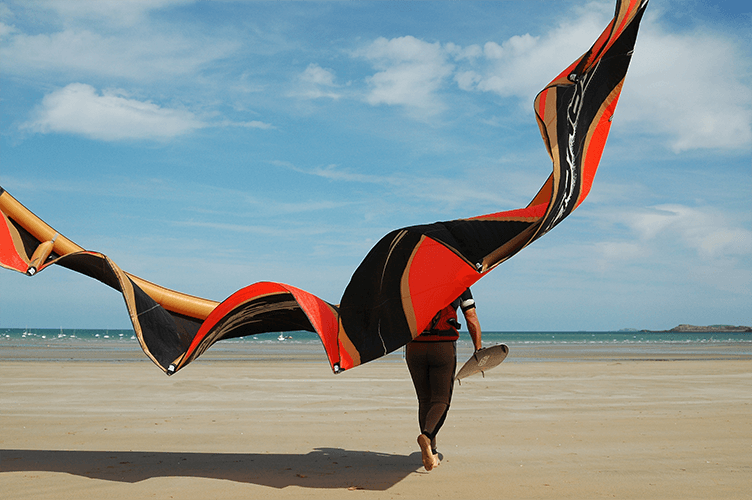
Image Composition Analysis
Subject Matter and Description
The photograph depicts a lone surfer walking barefoot across a wide, sandy beach, carrying a surfboard and a large, billowing kite. The scene is set beneath a bright blue sky scattered with soft clouds. The sea lies calm in the background, and the horizon is visible, bisecting the image in the lower third. The photo is taken from behind the surfer, whose body is partially obscured by the flowing structure of the kite.
Compositional Structure and Framing
Photographer’s Perspective and Camera Position
The photographer has chosen a low, slightly rear-facing position. This vantage point places the viewer just behind and slightly beneath the subject, giving a sense of grounded presence and immediacy. The low angle subtly emphasizes the sweep and arc of the kite, drawing the eye upward and outward. It also adds a sense of scale to both the subject and the beach, suggesting space and movement.
Use of the Frame
The kite dominates the frame, cutting through it in a dramatic, wave-like diagonal from the lower left to the upper right. This strong diagonal not only adds dynamism and energy but also divides the image into contrasting zones—air and land, movement and stability. The placement of the surfer slightly off-center adheres loosely to the rule of thirds, creating a more active composition than centering would provide. The frame edges are clean and deliberate. The kite’s leading edge enters and exits the frame with purpose, maintaining visual tension without unnecessary clutter.
Color Theory and Emotional Impact
The palette is composed primarily of three zones:
Background (sky/sea): Muted blues and gentle whites provide a calm, expansive canvas.
Foreground (sand): Warm, neutral tones dominate the bottom third, anchoring the image.
Subject (surfer and kite): Saturated reds, oranges, and blacks dominate the central and upper portions of the image.
This clash between the subdued background and the intense, saturated red and black of the kite creates color contrast that is both visually striking and emotionally energizing. Red and black are often associated with power, energy, and tension—traits echoed in the forward motion of the surfer and the kite’s dramatic shape. The aggressive color scheme breaks the visual stillness of the beach and sea, evoking movement and intent.
Lines, Movement, and Flow
The most prominent compositional feature is the sweeping C-curve of the kite, which mimics natural lines found in water or wind-blown fabric. This also contrasts the horizontal stability of the beach and horizon, adding dynamic asymmetry.
The figure of the surfer acts as a visual anchor amid the motion, offering a vertical contrast to the horizontal flow of waves and shoreline. His forward-leaning posture imply directionality and a narrative of purpose —each step a quiet declaration. He’s not just walking—he’s heading into challenge, calm and ready.
Spatial Relationships and Depth
Depth is created through three key spatial layers:
Foreground: Sand and shadows beneath the surfer’s feet.
Middle ground: The surfer and the kite.
Background: The ocean horizon and distant land masses.
There is no visual confusion, and the photograph demonstrates excellent spatial economy—every element contributes to the image’s clarity and impact.
Symbolic and Interpretive Layer
Beyond technical composition, the image invites interpretation. The surfer is isolated but empowered, navigating a large, powerful object—perhaps an analogy to harnessing natural forces or confronting a challenge. The oversized, flag-like nature of the kite might evoke themes of identity, resistance, or freedom.